Manually reviewing thousands of photos and technical documents from field installations is one of the most tedious processes in contracting and operating companies. Previously, in order to grow the business and execute more projects, a company had to proportionally expand its quality assurance (QA) analyst team. This generated significant costs, slowed down sign-offs, and limited the ability to scale operations.
Below is a detailed analysis of how a complex technological challenge was turned into a flexible business solution that completely relieved the team of routine work.
Operational Challenge and Field Data Quality
The previous process relied entirely on the manual work of a 7-person analyst team. Each photograph had to be individually verified for correct installation (including microduct placement, trays, or the presence of specific components). Analysts also had to catch fraud attempts and reject falsified photos.
At a scale reaching hundreds of thousands of objects, traditional automation was impossible due to the specific nature of field material:
- Lack of standardization: Field photos are taken from various angles under uneven lighting, and can be overexposed, out of focus, or completely blurry.
- Information noise: Redundant or completely unnecessary photos regularly appeared in documentation packages.
- Lack of AI training data: For a traditional computer vision model to work properly, it requires anywhere from 200 to even 1,000 labeled photos of each element. Meanwhile, for certain rare infrastructure components, there were only 30 real photographs in the database.
How Does the Solution Work? Translating Technology into Business Logic
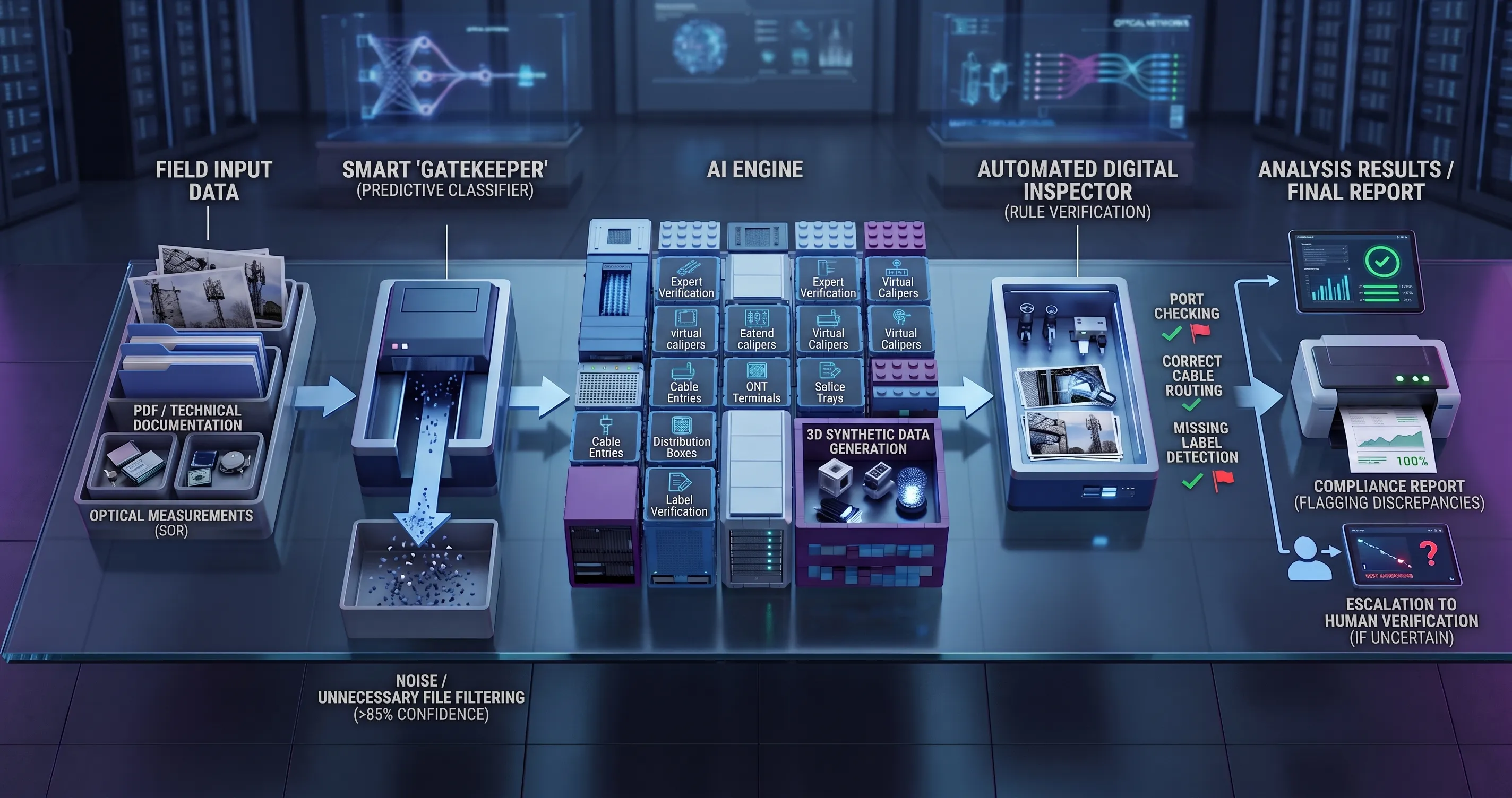
To solve these problems without having to build a heavy, rigid system, engineers used a modular approach (known as Composable AI). The platform operates like an ecosystem built from LEGO blocks – it can be flexibly configured for specific assignments without costly programming from scratch.
Step 1: Overcoming Data Scarcity (Synthetic Data)
Failures and rare components (for which there were only 30 photos) were digitally modeled. Instead of waiting months to collect hundreds of real field photos, synthetic data was used to train the artificial intelligence.
Step 2: A Team of 13 Digital Experts
Instead of one massive algorithm, 13 independent, specialized AI micro-models were created. Each is responsible for a narrow segment of the infrastructure (e.g., recognizing distribution boxes, optical terminals, splice trays, or cable entries). This makes the system flexible and easy to expand.
Step 3: Smart “Reception” and Cloud Cost Optimization
Analyzing every photo with all 13 models would generate extremely high server costs in the AWS cloud. Therefore, a lightweight predictive classifier was placed at the entry point. If it evaluates a photo with over 85% confidence, it instantly filters out unnecessary files and routes the remaining ones exclusively to the module that should actually analyze them.
Step 4: Automated Digital Inspector
The system not only recognizes objects in photos but also automatically checks their compliance with technical rules. Among other things, it analyzes whether a cable is plugged into the correct port and whether elements are arranged properly. Any deviations from standards are automatically flagged in the report.
Step 5: Document and Measurement Analysis (Beyond Images)
The platform goes beyond analyzing photos alone. It independently reads and classifies PDF protocols and processes binary files from optical measurements (SOR format from OTDR devices), checking whether signal levels fall within technical standards.
Step 6: Distinguishing Edge Cases and Human Collaboration
Devices such as the junction box (GFTA) and the optical terminal (ONT) are virtually identical to the naked eye. The AI was trained on negative examples to flawlessly distinguish these “twins.” Additionally, each AI evaluation includes a confidence score. If a case is ambiguous, the system hands it over to a human for verification, eliminating the risk of error and drastically reducing cognitive load on analysts.
Measurable Business Results and… Unexpected Discoveries
The existing 7-person team transformed repetitive work into an automated and repeatable process. Implementation results in numbers and facts:
- Work that a human would perform in a year, the system can complete in a week.
- Reduction of response time to errors from several weeks to as little as one day.
- The automated system checks 100%, or at least over 99% of cases, while a human performing statistical sampling covers only 10–15% of photos.
- The cost of connection verification relative to the product’s value is fixed and amounts to less than 1% of the total price.
Interestingly, after launching in one of the cities, the AI detected that 90% of the inspected devices were missing required identification labels – an error that eluded tired humans during routine inspections. It also uncovered an undocumented way of connecting cables, allowing management to respond and improve procedures ahead of future rollouts.
Universal Solution – Readiness for New Industries
The built architecture allows for a 10-fold increase in the volume of processed tasks without increasing headcount. Employees stopped being “button pushers” and became advisors and expert support.
The key advantage of the platform is that the issue of manual field data verification exists across many other economic sectors. Thanks to its modular design, the platform can easily be adapted to new use cases:
- Energy and RES – Automatic analysis of drone photos for high-voltage line damage, detection of microcracks in photovoltaic panels, and inspection of wind turbine blades.
- Construction – Supervision of work progress on construction sites, verification of structural assembly accuracy, and automated auditing of OHS requirements.
- Railway and Road Infrastructure – Automatic assessment of the condition of railway tracks, overhead power lines, signage, and road surface quality.
- Insurance and Claims Adjustment – Instant assessment and categorization of damage to buildings or vehicles based on photos submitted by clients.
Setting a New Quality Control Standard
Automating manual quality control represents a transition from reactive, error-prone human documentation checks to instantaneous, digital supervision at scale.
The takeaway from this implementation is clear: repetitive, monotonous data verification should no longer be a bottleneck in any company’s growth. Leveraging a flexible AI architecture relieves employees of routine work and allows their potential to be channeled where they generate the highest value – expert tasks, consultancy, and risk management.